1. Summary
This article puts the public facts in one place, separates what companies have confirmed from what attackers or commentators have claimed, and ends with the checks we would run first at a company without a dedicated security team. Every figure links to its source at the end of the page.
2. Timeline: late September to 9 October 2026
Dates are when the organisation detected or disclosed the incident, as reported. Record counts are the maximum each organisation said may be affected, not confirmed leaks.
3. Is a state behind it?
Japanese TV framed the wave as a question: is a nation-state behind it? Experts interviewed on air pointed instead to AI, describing attacks that scan many systems at once at a speed and scale that "does not look like human work".
The government has not drawn a conclusion. On 6 October the Chief Cabinet Secretary, Minoru Kihara, said it is not clear whether the incidents are related and that the government is analysing the methods and trends of the attacks. The National Police Agency's study of attack methods is due next March.
Of the disclosures we read, none names an attacker. From a defender's point of view the more useful question is how each attacker got in, because that is the part a company can change this month.
4. How the attackers got in
Grouped by entry point, the disclosures that give a cause fall into five patterns.
A vendor's server
Scala Communications runs an FAQ and inquiry system for up to five client companies. One overnight intrusion exposed about 110,000 Daiwa Securities customers and about 100,000 people who had contacted Citizen Watch. Tokyo Metro's 59,000 email addresses sat on an outsourced mail vendor's server. Yoshinoya's applicant data was taken from ApplyNow, a recruiting platform it no longer used.
API and configuration
Shueisha attributes its incident to a CMS configuration error. The attacker went after API authentication, created a high-privilege account and pulled records through repeated API requests.
Software vulnerabilities
GMO Research & AI cites a vulnerability in software used by its infoQ survey site. Mr Max describes misuse of a feature of the software that runs its app and online store. ApplyNow cites a vulnerability in a data analysis tool.
Identity
At Nikkei, one employee's Microsoft 365 account sent about 9,000 phishing emails on 30 September. A separate Google Workspace account had been accessed since late July; Google flagged it.
The virtualization layer and the cloud
At Osaka Metropolitan University the attacker reached the virtualization platform that many university systems run on. About 500 servers stopped, and most of the backups were encrypted too. At IDC Frontier, virtual servers in four zones of one region cannot restart, and the provider has told customers that data there will be difficult to recover and to restore from their own backups.
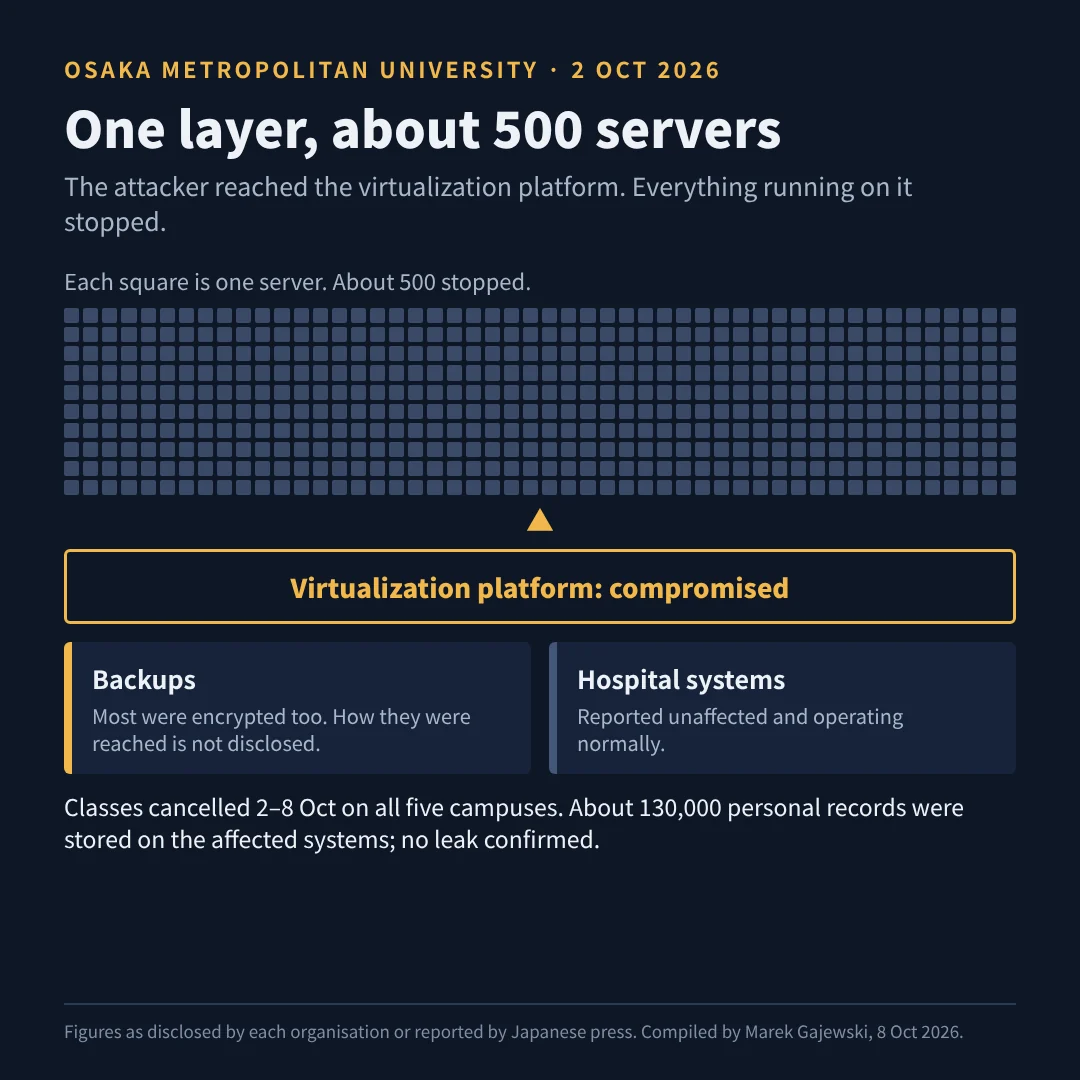
The common thread: none of these entry points needs a new capability. Vendor servers, API settings, unpatched software, single accounts and shared infrastructure are long-known weaknesses. If AI is changing anything, it is the speed at which they are found.
5. How long it took to notice, and who noticed
The time between the first access and discovery varies widely, and so does who raised the alarm.
- ApplyNow: 29 days, from 9 August to 7 September.
- Nippon Rent-A-Car: accessed on 19 to 21 September and found on the 29th, while the team was investigating a different break-in.
- Tokyo Metro: five days from the first symptom, a mail delivery fault, to confirming the access.
- Shueisha: about 14 hours. The alert came from a recipient who reported a strange email.
- Abahouse: customers reported refund emails that quoted their real orders.
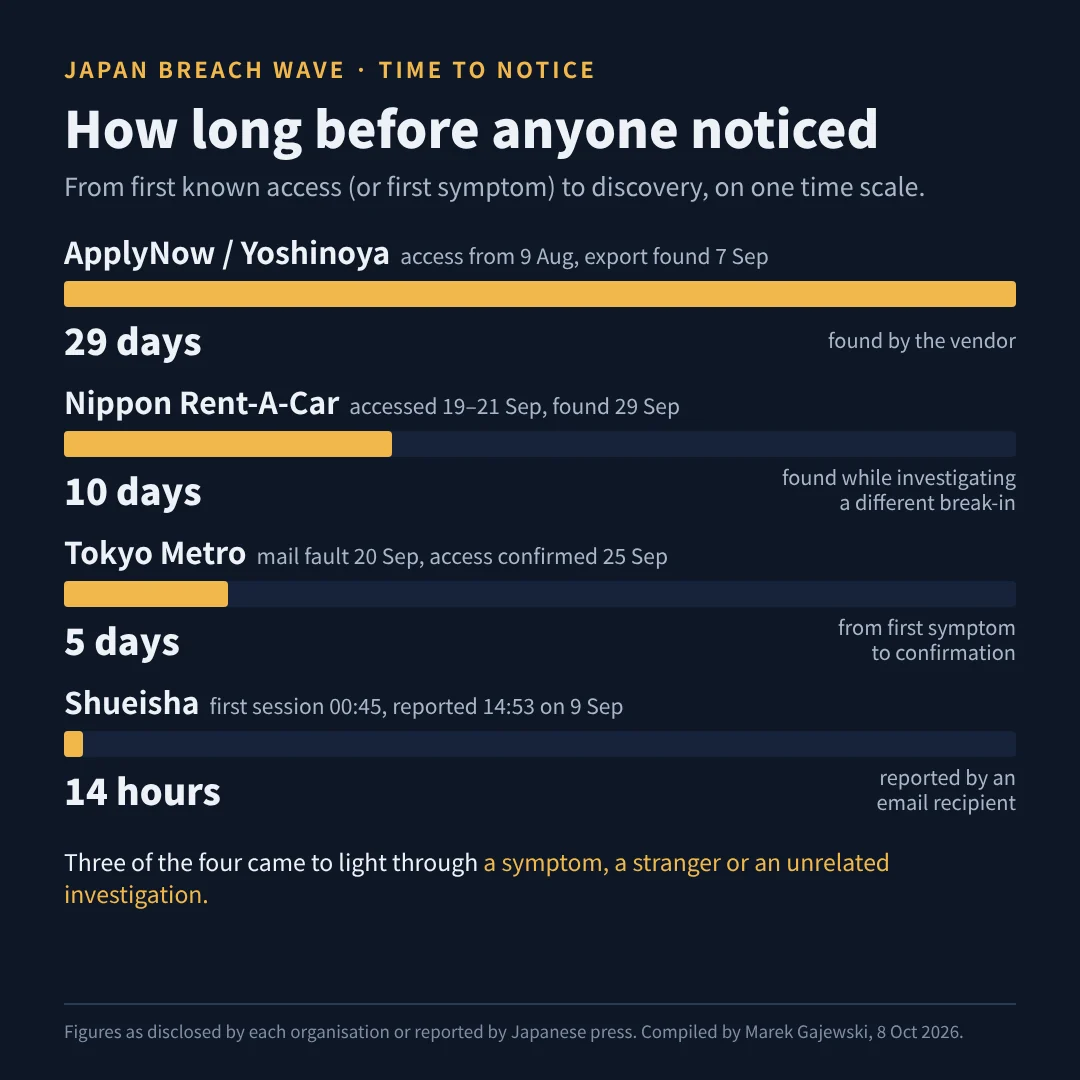
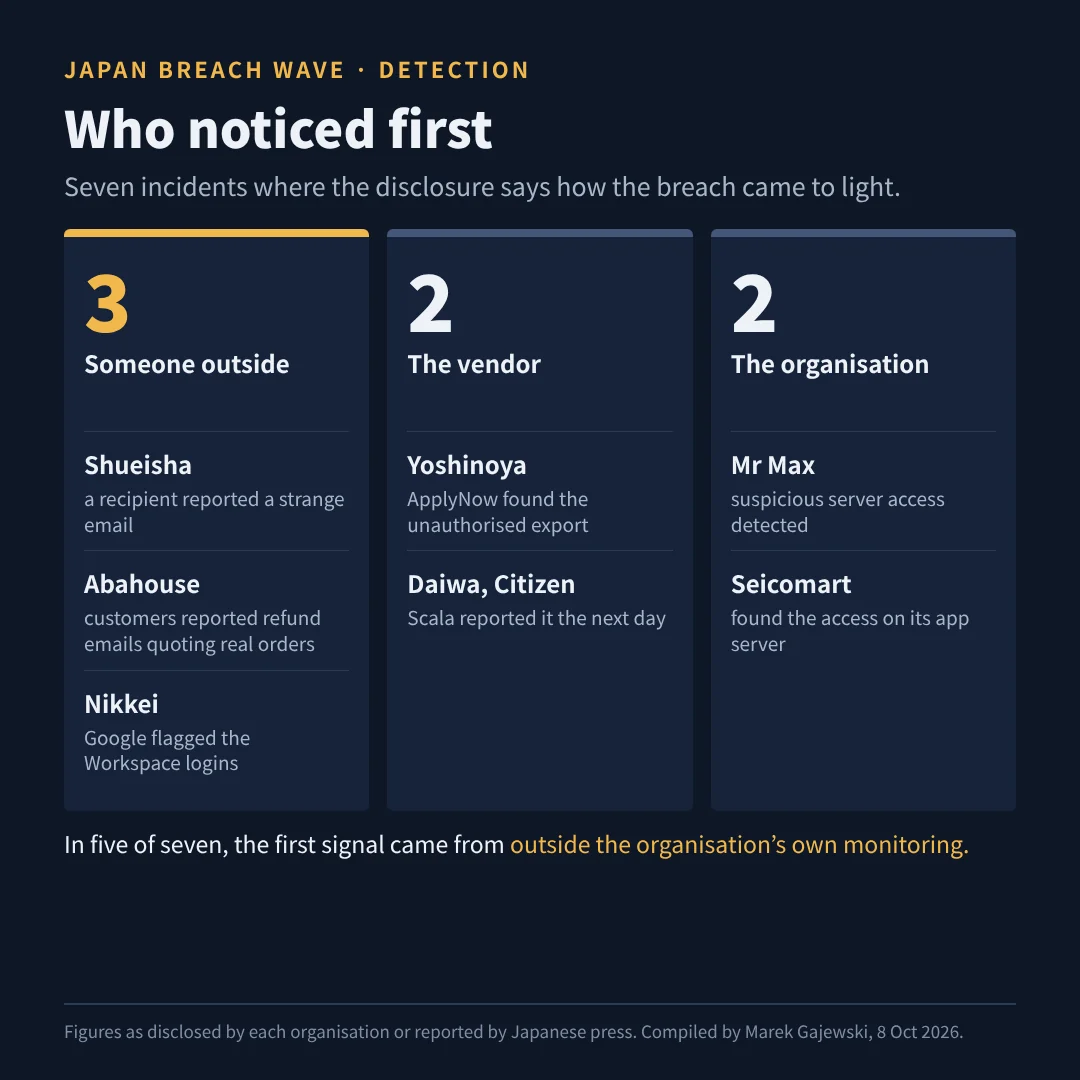
In five of those seven incidents the first signal came from outside the affected organisation's own monitoring: a customer, a stranger, a platform provider or a vendor. The attackers' message left at IDC Frontier claims the encryption took seven minutes. IDC Frontier says it is still investigating that message, so treat the figure as a claim. If it is anywhere near true, detection measured in days comes too late.
6. Ransomware in Japan in 2026
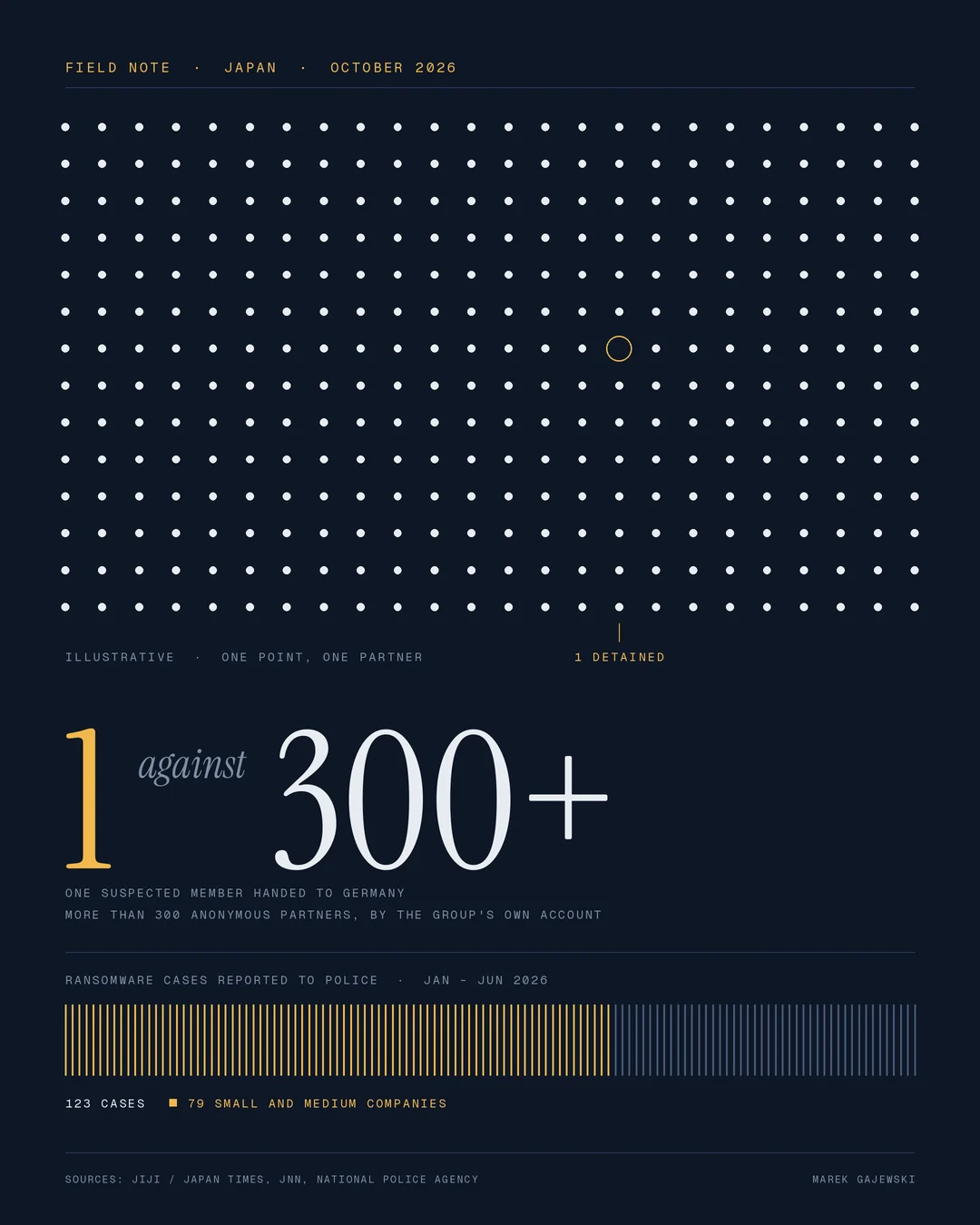
The National Police Agency counted 123 ransomware cases in the first half of 2026, the highest half-year figure since its statistics began. 79 of them hit small and medium companies. About half of the victims surveyed were first entered through a VPN device, about 60% spent ¥10 million or more on recovery, and fewer than half were back to normal within a month.
In early October, Japanese police located a Russian national believed to be a key member of the Qilin ransomware group, which claimed the 2025 outage at Asahi Group Holdings, and handed him to Germany at the German authorities' request. The group told JNN that Japan has "one of the worst computer security systems in the world" and that attacks on Japanese companies could increase. It says it works with more than 300 anonymous partners, which is why one arrest does not change the risk to a company's VPN.
A public tracker of ransomware leak sites listed at least 34 Japanese organisations between 1 August and 12 October 2026, with Qilin claiming seven. These are criminal claims, not confirmed breaches, so we do not name the organisations here.
7. What a small company should check first
For a company without a security team, these checks cost far less than the ¥10 million most ransomware victims spend on recovery. They are ordered by how directly they map to the entry points above.
- Patch or replace your VPN appliance, and put multi-factor authentication in front of it. VPN devices were the most common first entry point in the police data.
- Keep one backup that neither your IT provider, your hypervisor credentials nor your cloud provider can reach, and restore from it once. Osaka and IDC Frontier both show backups or recovery depending on the same layer that failed.
- List every outside company that holds your customer data. For vendors you have left, get written confirmation that the data was deleted. Ask current vendors how long they keep logs and who reviews them.
- Alert on new privileged accounts, especially accounts created through an API or outside change windows.
- Review sign-ins every day, starting with Microsoft 365 or Google Workspace. A login from an unexpected country should be seen the next morning, not reported by a customer.
- Write down who you will call. Your IT provider, your cloud provider, a forensic partner, and the police and Personal Information Protection Commission reporting routes.
For the wider picture of threats and regulation in Japan, see our guide to cybersecurity in Japan.
8. Frequently asked questions
Which Japanese organisations disclosed breaches in October 2026?
Among others: Times Car, Tokyo Metro, Keio Plaza Hotel, Shueisha, Seicomart, Osaka Metropolitan University, Daiwa Securities and Citizen Watch (through Scala Communications), Yakiniku King, GMO Research & AI, Nikkei, Mr Max, IDC Frontier and its customers including JR East and Views Card, Book Off and Sky Ticket. TV Asahi counted more than 40 announcements in about a month.
Was the IDC Frontier incident ransomware?
Yes. IDC Frontier confirmed a third-party ransomware attack on its IDCF Cloud East Japan Region 1, starting at about 03:40 on 7 October 2026, affecting 495 companies and local governments. Figures in the attackers' own message are unverified.
Is a nation-state behind the attacks?
There is no public evidence either way. The Chief Cabinet Secretary said on 6 October that it is not clear whether the incidents are related, and none of the disclosures we read names an attacker.
How did the attackers get in?
Where a cause was disclosed: vendor servers (Scala Communications, an outsourced mail service, ApplyNow), a CMS configuration error (Shueisha), software vulnerabilities (GMO Research & AI, Mr Max, ApplyNow), compromised accounts (Nikkei), and the virtualization or cloud layer (Osaka Metropolitan University, IDC Frontier).
What should a small company do first?
Patch or replace the VPN appliance and add multi-factor authentication, keep one backup that the IT provider and cloud provider cannot reach and test a restore, list every vendor that holds customer data, and make sure someone reviews sign-in logs every day.
Would anyone notice tonight?
CS2 SecureWatch connects read-only to the logs you already have (Microsoft 365, Google Workspace, AWS, network devices, servers and e-commerce sites), triages them every day and sends a short daily report in Japanese and English, with alerts within minutes for high-severity events. It does not see inside your vendors' systems; it watches your own environment, every day.
About SecureWatchSources
- IDC Frontier ransomware, East Japan Region 1, 495 organisations (TECH+)
- IDC Frontier third report: recovery from customers' own backups
- Attacker message at IDC Frontier and the company's response
- JR East and Views Card, possible exposure via IDC Frontier (NHK)
- Book Off, up to 6.43 million records (NHK)
- Sky Ticket, more than 14 million records (NHK)
- Times Car, about 6.6 million records (@IT)
- Yakiniku King, 10,788,963 records
- Daiwa Securities and Scala Communications (INTERNET Watch)
- Citizen Watch and Scala Communications
- Mr Max, up to 1,735,154 members (Impress NetShop)
- GMO Research & AI infoQ
- Seicomart, about 570,000 accounts (ScanNetSecurity)
- Tokyo Metro, about 59,000 email addresses
- Shueisha, 2,835 bloggers (ITmedia NEWS)
- Yoshinoya and ApplyNow (ITmedia NEWS)
- Nikkei, Microsoft 365 and Google Workspace incidents
- Abahouse (Fashionsnap)
- Nippon Rent-A-Car, second access method
- Keio Plaza Hotel notice
- Osaka Metropolitan University ransomware
- Government response and Scala's client count (The Japan Times)
- Qilin suspect handed to Germany (Jiji / The Japan Times)
- Qilin statement to JNN (News On Japan)
- National Police Agency, first half of 2026 (@IT)
- Ransomware leak-site tracker, Japan
Figures are as disclosed by each organisation or reported by Japanese media as of 13 October 2026. Many counts are the maximum number of records that may be affected, not confirmed leaks. Investigations are ongoing and some figures may change.